Installing and Deploying QATrack+ on Windows Server
Note
This guide assumes you have at least a basic level of familiarity with Windows Server, SQL Server Management Studio, and the command line.
There are many community members who have successfully installed QATrack+ on Windows Server and can provide guidance and support. You can reach out to the QATrack+ community through the QATrack+ Google Group for assistance.
New Installation
This guide is going to walk you through installing QATrack+ on a Windows Server 2022 server with IIS serving static assets (images, javascript and stylesheets) and acting as a reverse proxy for a CherryPy web server which serves our Django application (QATrack+). The instructions have been tested with SQL Server 2022 database (and SQL Express).
If you are upgrading an existing QATrack+ installation from version 3.1, please see:
Note
This guide assumes you have SQL Server Management Studio (SSMS) and Internet Information Services (IIS) installed/enabled
The steps we will be undertaking are:
Prerequisites
Before beginning the installation, ensure the following software is installed on your server:
Google Chrome: Required to generate or schedule PDF reports.
Microsoft Visual C++ Redistributable: The ODBC Driver for SQL Server requires this.
ODBC Driver 17 for SQL Server: Required for QATrack+ to communicate with the database.
SQL Server Management Studio (SSMS): Required for setting up the database.
Git for Windows: Required to check out the QATrack+ source code.
For convenience, these installers may be kept in a folder on the server (e.g. C:\deploy\installers) for future reference and re-use.
SQL Server Express: Required if you do not have access to a full SQL Server instance SQL Server may be installed locally. This option should only be used if local IT resources will not support using a full SQL Server instance. QATrack+ should fit within the licensing limits of SQL Server Express, but it is up to each site to confirm their Microsoft licensing requirements.
IIS requires the URL Rewrite 2.1 and Application Request Routing 3.0 modules.
Installing Python 3.12
Download the Python 3.12.10 (64-bit) installer: https://www.python.org/ftp/python/3.12.10/python-3.12.10-amd64.exe
We need to be careful to ensure Python is installed for all users and that the Python executable is added to the PATH variable. Here we will step through the installation process to ensure this is the case.
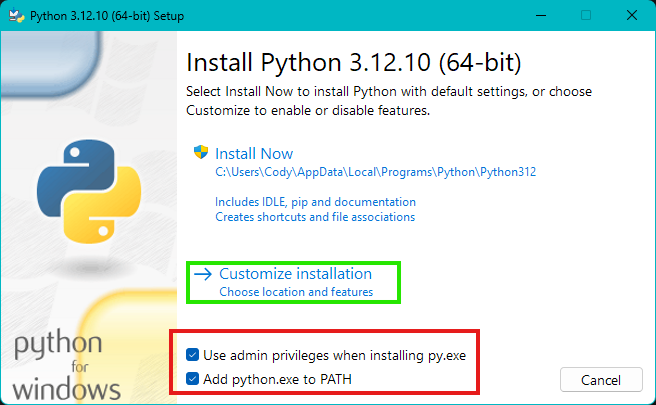
Select the checkboxes to install for all users and add Python to PATH, then click “Customize Installation” to continue.
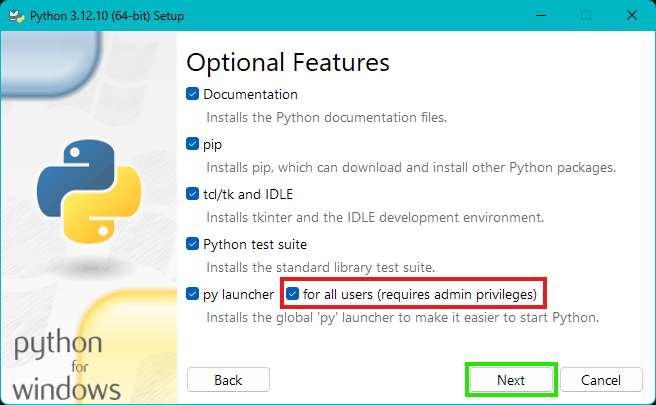
Leave the defaults, check that the “Install for all users” option is selected, and click “Next” to continue.
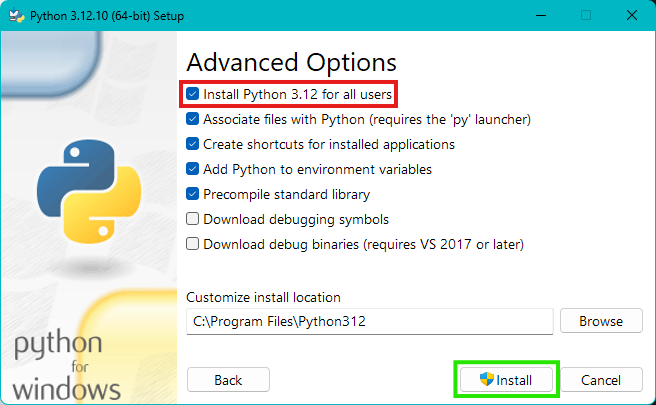
Ensure “Install for all users” is selected, then click “Install” to continue. The installer will now run, before it finishes you may be prompted to Disable path length limit. Select this option if prompted.
Once complete, we can verify the installation in a command prompt or a PowerShell terminal by running the following command:
>>  python --version
# this should print Python 3.12.10
Checking out the QATrack+ Source Code
Open a Windows PowerShell terminal and then create a directory for QATrack+ and check out the source code, use the following commands:
>>  mkdir C:\deploy
>>  cd C:\deploy
>>  git clone https://github.com/qatrackplus/qatrackplus.git
Setting up our Python environment
We’re now ready to install all the libraries QATrack+ depends on.
>>  cd qatrackplus
>>  git checkout v4.0.0
>>  pip install uv
>>  uv sync --extra win --extra mssql
>>  .\.venv\Scripts\Activate.ps1
Warning
If you are going to be using Active Directory for authenticating your users, you need to install pyldap. There are binaries available on this page: https://github.com/cgohlke/python-ldap-build. Download the relevant wheel for your distribution (e.g. python_ldap-3.4.5-cp312-cp312-win_amd64.whl) and install it directly into your venv:
uv pip install C:\path\to\python_ldap-3.4.5-cp312-cp312-win_amd64.whl
Creating a database with SQL Server
If you, or your IT department has familiarity with SQL Server, here is a quick summary of the configuration needed.
a SQL Server instance (either local or remote) with SQL Server Authentication enabled.
a database named qatrackplus40.
a database user named qatrack with db_ddladmin, db_datawriter, db_datareader and db_owner permissions on the qatrackplus40 database.
a database user named qatrack_reports with db_datareader permissions on the qatrackplus40 database.
For most of us, the easiest way to set this up is to use SQL Server Management Studio (SSMS) and follow the instructions below. If you have a different method of setting up your database that meets the above requirements, that will work too.
Ensure SQL Server Authentication is enabled
Open SQL Server Management Studio and connect to ‘localhost’ or another database server.
In the Object Explorer frame right click on the server you are connected to and click Properties. In the dialog that opens click on Security, ensure SQL Server and Windows Authentication mode is selected and then click OK. Now right click on your server again and click Restart.
Create a new database
In the Object Explorer frame, right click the Databases folder and select “New Database…”.
Enter ‘qatrackplus’ as the database name and click OK.
Back in the Object Explorer frame, right click on the main Server Security folder and click New Login… Set the login name to ‘qatrack’, select SQL Server Authentication. Enter ‘qatrackpass’ (or whatever you like) for the password fields and uncheck Enforce Password Policy. Click OK.
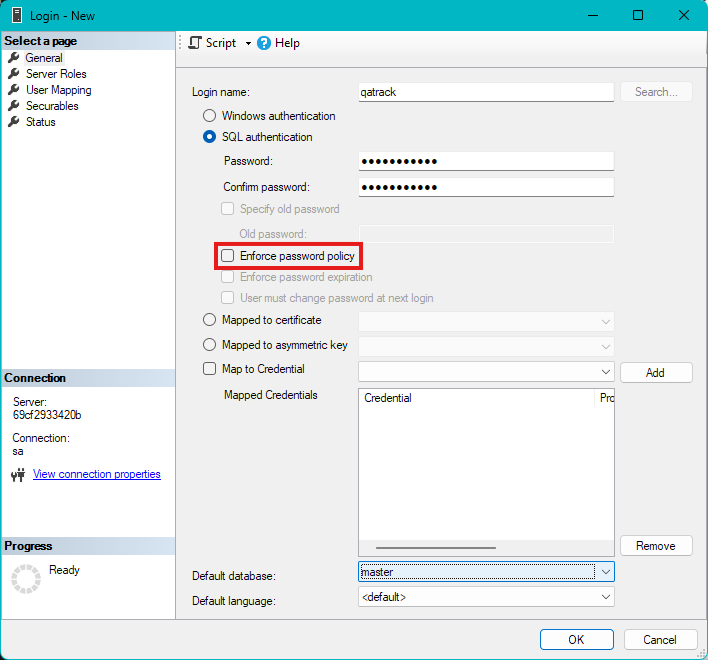
Again in the Object Explorer frame, right click on the main Security folder and click New Login… Set the login name to ‘qatrack_reports’, select SQL Server Authentication. Enter ‘qatrackpass’ (or whatever you like) for the password fields and uncheck Enforce Password Policy. Click OK.
Now we have a database and two users, but the users don’t have permissions to do anything with the database yet. Back in the Object Explorer frame expand the qatrackplus database, right click on Security and select New->User.
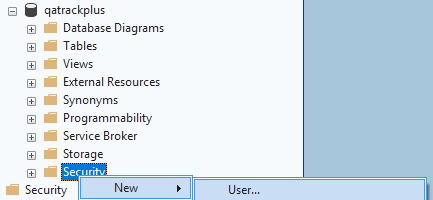
Enter ‘qatrack’ as both the User name and Login name and then in the Database Role Membership region select ‘db_ddladmin’, ‘db_datawriter’, ‘db_datareader’ and ‘db_owner’. Click OK.
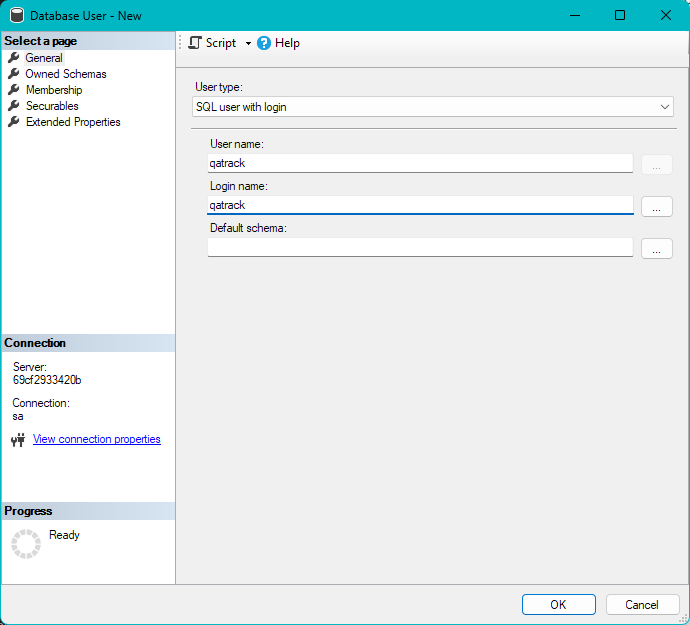
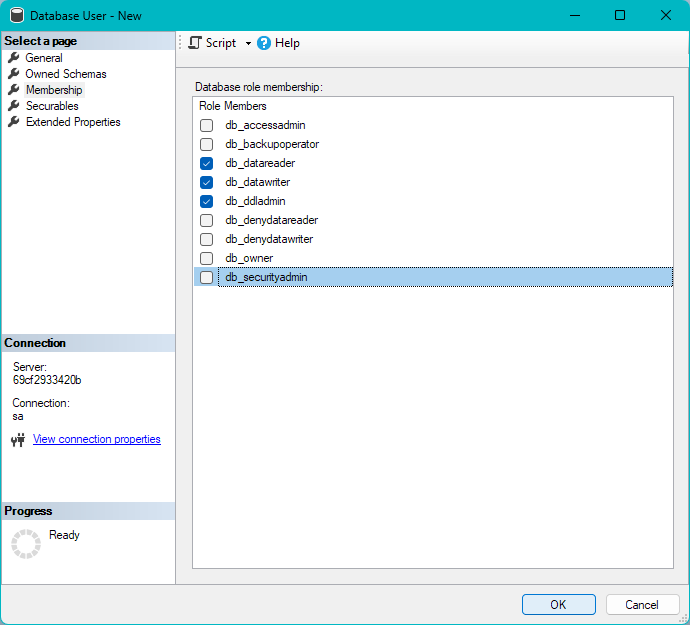
The second user is readonly since it will only be used for queries and reports. In the new user dialog,enter ‘qatrack_reports’ as the User name and Login name and then in the Database Role Membership region select ‘db_datareader’. Click OK.
Configuring QATrack+ to use your new database
Copy the example local_settings file:
>> cp deploy\win\local_settings.py qatrack\local_settings.py
and then edit it so that the NAME, USER, and PASSWORD settings match the way you set up your database above. Also, ensure you configure CSRF_TRUSTED_ORIGINS which is required. You can find your Device Name by pressing Windows Key + I -> System -> About. Alternatively, you can use hostname in a command prompt to get your device name, and ipconfig to get your IP address.
Your local_settings.py file should look something like the following (but with the correct values for your server):
DEBUG = False

DATABASES = {
    'default': {
        'ENGINE': 'mssql',
        'NAME': 'qatrackplus40',
        'USER': 'qatrack',  # USER/PWD can usually be left blank if SQL server is running on the same server as QATrack+
        'PASSWORD': 'qatrackpass',
        'HOST': '', # leave blank unless using remote server or SQLExpress (use 127.0.0.1\\SQLExpress or COMPUTERNAME\\SQLExpress)
        'PORT': '', # Set to empty string for default. Not used with sqlite3.
        'OPTIONS': {
            'driver': 'ODBC Driver 17 for SQL Server'
        },
    },
    'readonly': {
        'ENGINE': 'mssql',
        'NAME': 'qatrackplus40',
        'USER': 'qatrack_reports',
        'PASSWORD': 'qatrackpass',
        'HOST': '',
        'PORT': '',
        'OPTIONS': {
            'driver': 'ODBC Driver 17 for SQL Server'
        },
    }
}

ALLOWED_HOSTS = [
    '127.0.0.1',
    'localhost',
    'YOUR_DEVICE_NAME',
    'YOUR_IP_ADDRESS']

CSRF_TRUSTED_ORIGINS = [
    'http://localhost',
    'https://localhost',
    'http://127.0.0.1',
    'https://127.0.0.1',
    'http://YOUR_DEVICE_NAME',
    'https://YOUR_DEVICE_NAME']
Confirm you can connect to your database by running the showmigrations command:
>> python manage.py showmigrations accounts
which should show output like:
accounts
    [ ] 0001_initial
    [ ] 0002_activedirectorygroupmap_defaultgroup
    [ ] 0003_auto_20210207_1027
    [ ] 0004_Auto_BigAuto_TimeZone_Django42
We will now create the database tables and load some configuration data into our new database from the command prompt. Createsuperuser will prompt you to create the highest level admin user for logging into QATrack+. Make sure to remember the username and password you create here as you will need it to log in to QATrack+ for the first time!
Now run the following commands to set up your database and load the default configuration data:
>>  python manage.py migrate
>>  python manage.py createsuperuser
>>  python manage.py createcachetable
>>  python manage.py collectstatic
>>  Get-ChildItem .\fixtures\defaults\*\*json | foreach {python manage.py loaddata $_.FullName}
We now have a database, we have configured QATrack+ to use it, and we’ve loaded the default configuration data. Next, we should test that everything is working correctly by running the development server with python manage.py runserver and navigating to http://localhost:8000/ in a browser on the server. You should see a poor approximation of the QATrack+ login page (it won’t look like this once we’re finished!). If you see any errors, check the terminal output for details on what went wrong. If you can log in successfully, then we know our database is configured correctly and we can move on to the next step.
Configuring CherryPy to Serve QATrack+
Next we need to set up a web server to serve QATrack+ and allow users to log in and use it. In order to have QATack+ start when you reboot your server, or restart after a crash, we will run QATrack+ with a CherryPy server installed as a Windows service (running on port 8080, see note below if you need to change the port).
Open a new PowerShell window with Administrator privileges (right click on PowerShell and click “Run as Administrator”) and run the following commands:
>>  cd C:\deploy\qatrackplus
>>  .\.venv\Scripts\Activate.ps1
>>  cp deploy\win\QATrack40CherryPyService.py .
>>  python .\.venv\Scripts\pywin32_postinstall.py -install
>>  python QATrack40CherryPyService.py --startup=auto install
>>  python QATrack40CherryPyService.py start
Open the Windows Services dialog and confirm the QATrack 40 CherryPy Service is installed and has a status of Running.
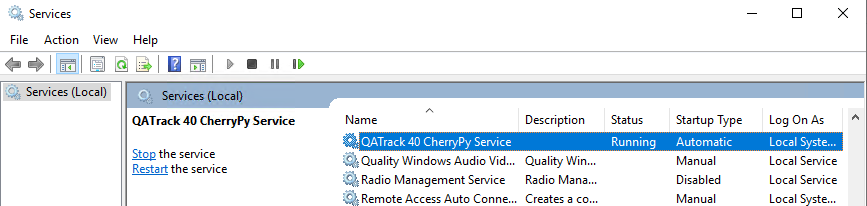
Next open a browser on the server and navigate to http://localhost:8080/ and ensure you see a plain login form there (it won’t look like this once we’re finished!). If not, check the logscherry_py_err.log file for any errors.
Your QATrack+ installation is now installed as a Windows Service running on port 8080 (see note below). You may also wish to configure the service to email you in the event of a crash (see the Recovery tab of the QATrackCherryPyService configuration dialogue).
Note
If you need to run QATrack+ on a different port, edit C:\deploy\qatrackplus\QATrack3CherryPyService.py and set the PORT variable to a different port (e.g. 8008)
Setting up IIS
To start open up the Internet Information Services (IIS) application. We are going to use IIS for two purposes: first, it is going to serve all of our static media (css, js and images) and second it is going to act as a reverse proxy to forward the QATrack+ specific requests to CherryPy.
If IIS is not installed, open Server Manager, select Manage -> Add Roles and Features, click Next until you reach Server Roles, check Web Server (IIS), and follow the prompts to install it. The default options are sufficient.
Before configuring IIS, please make sure you have both URL Rewrite 2.1 and Application Request Routing 3.0 IIS modules installed. These can be installed manually from the provided links.
After installing these modules, you will need to close & re-open IIS. Alternatively, the deploy\win\iis_install.ps1 script can automate some of this setup. When testing static access, ensure the IIS server is running.
Enabling Proxy in Application Request Routing
Application Request Routing needs to have the proxy setting enabled. To do this, click on the top level server in the left side panel, and then double click the Application Request Routing icon. In the Actions panel click the Server Proxy Settings and then check Enable proxy at the top. Leave all the other settings the same and click Apply and then Back to ARR Cache.
Enabling Static Content Serving in IIS
IIS is not always set up to serve static content. To enable this, open the Server Manager software, click Manage, then Add Roles and Features then Next, Next. In the Roles widget, select Web Server(IIS)->Web Server->Common HTTP Features and make sure Static Content is selected. If it isn’t, enable that role.
Setting up the site and URL rewrite rules
Once you have Application Request Routing installed and proxies enabled, in the left panel of IIS under Sites, select the default Web Site and click Stop on the right hand side.
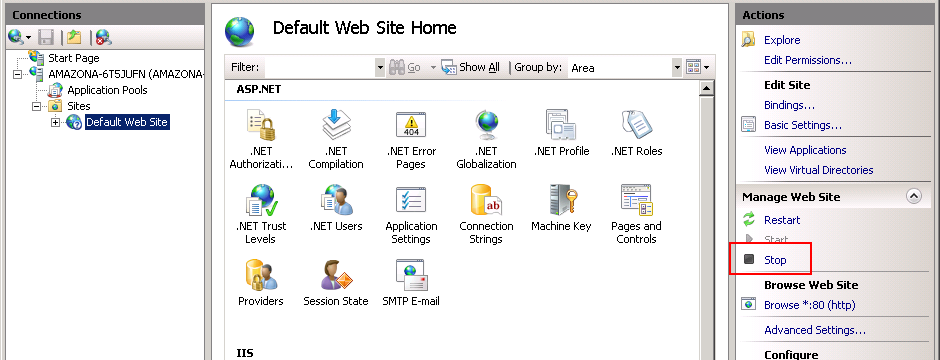
Stop default website
Now right click on Sites and click Add Web Site
Add a new web site
Enter QATrack Static for the Site Name and “C:\deploy\qatrackplus\qatrack\” for the Physical Path then click OK and answer Yes to the warning.
To test that setup worked correctly open a browser on your server and enter the address http://localhost/static/qa/img/tux.png You should see a picture of the Linux penguin.

Next, select the top level server in the Connections pane and then double click URL Rewrite:
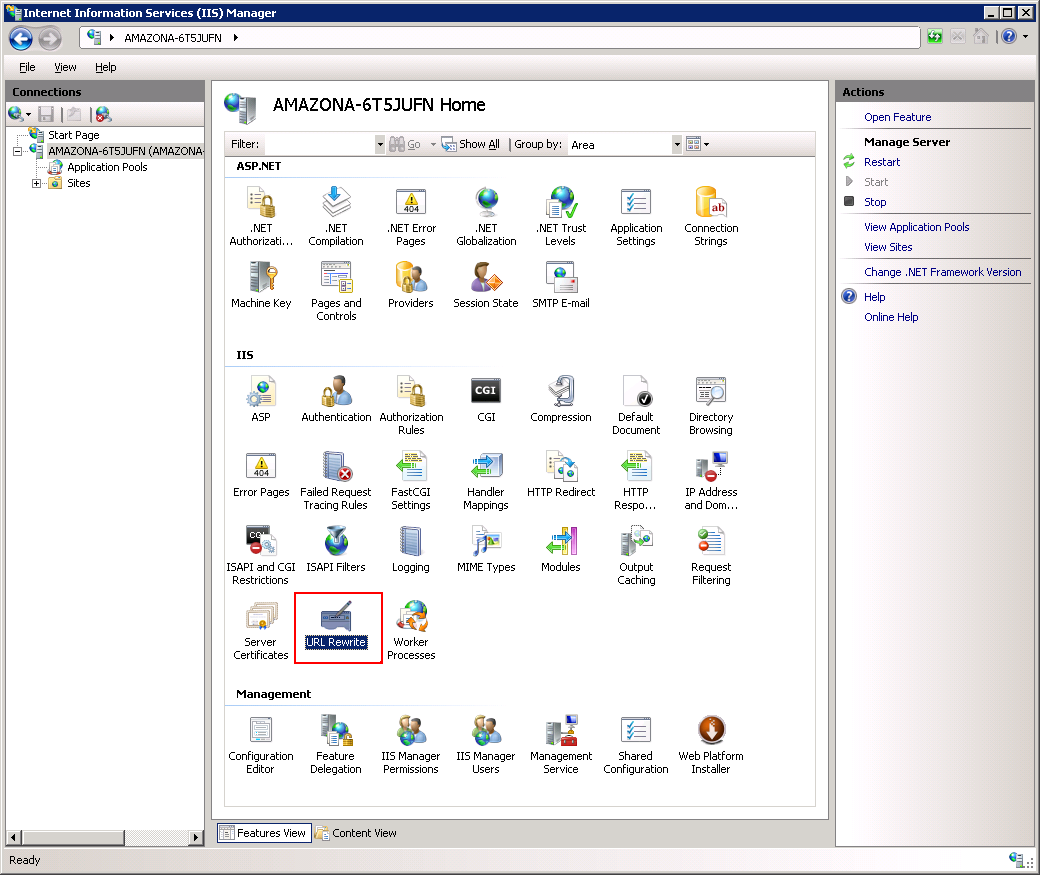
URL Rewrite
In the top right click Add Rule and select Blank Rule.
Give it a name of QATrack Static and enter ^(static|media)/.* for the Pattern field, and select None for the Action type. Make sure Stop processing of subsequent rules is checked.
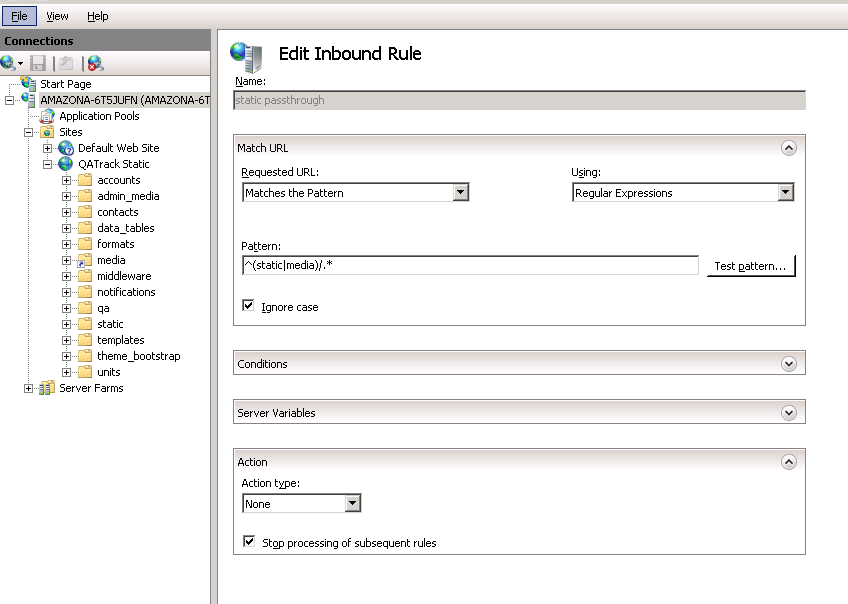
Static URL Rewrite Rule
When finished click Apply, then Back To Rules and then add another blank rule. Give it a name of QATrack Reverse Proxy, enter ^(.*) for the Pattern and http://localhost:8080/{R:1} for the Rewrite URL. In the Server Variables section add a new Server Variable with the Name=HTTP_X_FORWARDED_HOST and the Value=yourservername.com (replace yourservername with whatever your domain is!). Finally, make sure both Append query string and Stop processing of subsequent rules are checked.
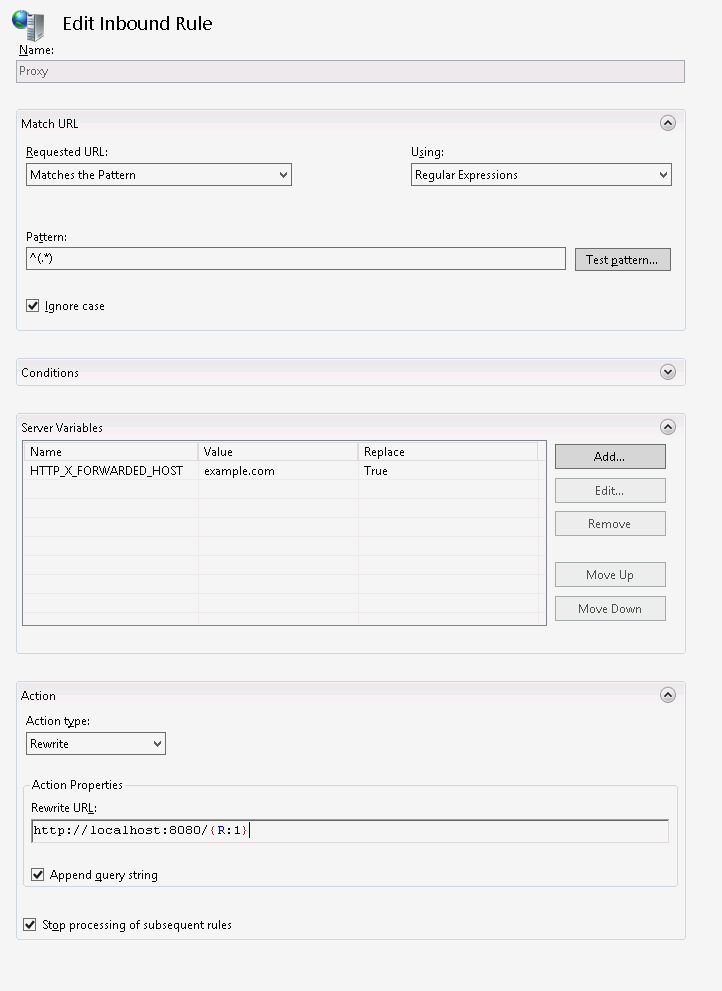
URL Rewrite Reverse Proxy
Your URL rewrites should look like the following (order is important!)

URL Rewrite rules
You should now be able to visit http://localhost/ in a browser on your server and see the QATrack+ login page. Congratulations, you now have a functional QATrack+ setup on your Windows Server!
If you see a “403.14 Forbidden” error, double check you added the URL rewrite rules to the top level server, and not the QATrack Static site.
If you see a “502.3 Bad Gateway” error, double check that your QATrack CherryPy service was installed correctly and is running.
Note
There are many different ways to configure IIS. The method I’ve used above is simple and works well when QATrack+ is the only web service running on a server.
Setting up Django Q
As of version 3.1.0, some features in QATrack+ rely on a separate long running process which looks after periodic and background tasks like sending out scheduled notices and reports. We are going to use Windows Task Scheduler to run the Django Q task processing cluster.
Open the Windows Task Scheduler application and click Create Task. Give the task a name of “QATrack+ Django Q Cluster”. Click the Change User or Group… button and in the Enter the object name to select box put SYSTEM, then click Check Names and OK.
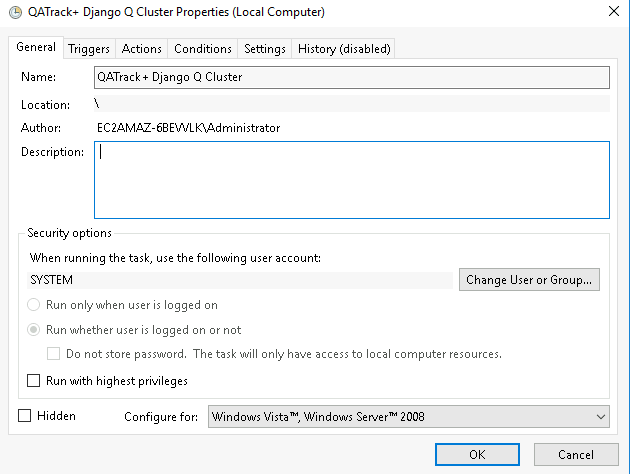
QCluster Task
On the Triggers tab, click New… and in the Begin the task: dropdown select At startup and then click OK.
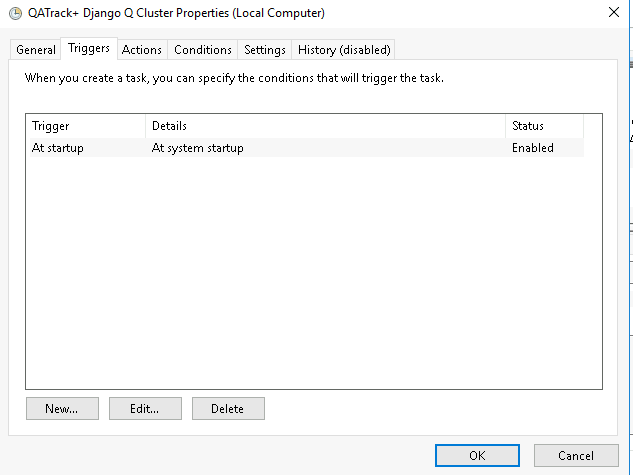
QCluster Trigger
Now go to the Actions tab and click New…. In the Program/script: box enter C:\deploy\qatrackplus\.venv\Scripts\python.exe. In the Add arguments (optional): field enter manage.py qcluster, and in the Start in (optional): field put C:\deploy\qatrackplus (no trailing slash!).
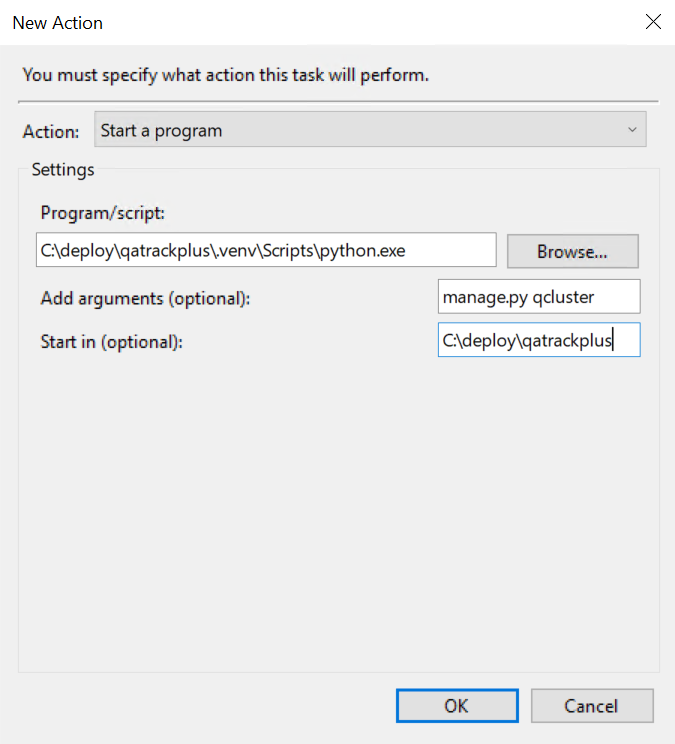
QCluster Action
Click OK, then right click on the task and select Run. Go back to your PowerShell window (or open a new one) and confirm your task cluster is running with python manage.py qmonitor which should show something like:
 Host            Id      State    Pool    TQ       RQ       RC    Up

YOUR-SERVER    e0474f3f  Idle     2       0        0        0     0:05:53

     ORM default     Queued    0    Success   48   Failures       0

                     [Press q to quit]
If the line between Host and ORM default is blank then there is a problem with the Windows Task you created.
What Next
Check the the settings page for any available customizations you want to add to your QATrack+ installation (don’t forget to restart both your QATrack CherryPy Service, and Django Q cluster via the task scheduler after changing any settings!)
Set up a Backup Strategy. You must routinely backup your database, the media folder, and your local_settings.py file. Please consult with your IT department to automate this. More details can be found here: backup of your QATrack+ installation.
Read the Administration Guide, User Guide, and Tutorials.
Wrap Up
This guide shows only one of many possible method of deploying QATrack+ on Windows. It is very similar to what is used at The Ottawa Hospital Cancer Centre and it has proven to be a very solid setup. If you’re stuck with a Windows stack it will likely work for you too. Please post on the QATrack+ Google Group if you get stuck!